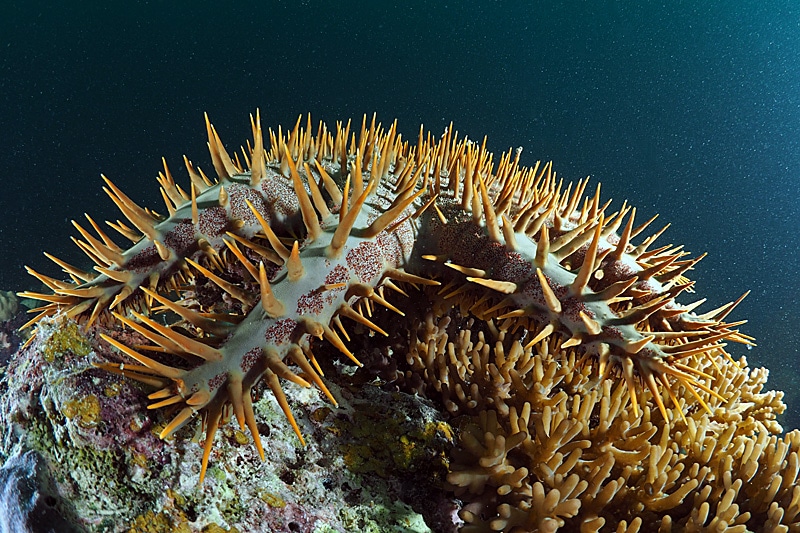
In 2015, the Khaled bin Sultan Living Oceans Foundation launched the Starfish Control and Removal (SCAR) Program to combat outbreaks of deadly crown-of-thorns starfish (COTS). The program successfully removed thousands of COTS starfish in the Cook Islands, the Maldives, and other small-island nations in the Indo-Pacific.
The primary goals of the SCAR program were to:
- Control and remove COTS during an outbreak
We rapidly controlled and removed COTS during an outbreak, mitigating damage to the coral reef. During the removal process, our team of scientists recorded the distribution and abundance of COTS as well as their prey preferences and feeding rates. They also assessed the extent of the damage to corals in the area. Genetic samples were taken, and we attempted to determine the source population and patterns of spread. Scientists returned to these same reefs after the COTS outbreak to survey the health of the coral reef and collect data on the rate and pattern of recovery. - Train people to safely combat a COTS outbreak
Training sessions and seminars were held for local dive operators, communities, resort staff, and tourists, focusing on COTS ecology and techniques to locally eradicate this species from the reef. - Provide a global database on COTS
The SCAR program aimed to act as a central location for reporting COTS outbreaks and serve as a repository for global data on COTS occurrence and impacts.
Countries in the Indo-Pacific depend heavily on their coral reefs and associated resources for food, revenue, and protection from storms. Without corals, the fish that depend on reefs for feeding, shelter, and breeding grounds will disappear. With millions of tourists visiting coral reef nations every year, COTS outbreaks have the potential to have a devastating impact on coastal communities across the region. Although it isn’t feasible to prevent outbreaks of COTS from occurring, localized efforts to irradiate the species have proven to be successful at preventing a reef from being decimated by COTS and maintaining the health and resiliency of the coral reef.
Learn More About Crown-of-Thorns Starfish (COTS)
Coral reefs are undergoing a worldwide crisis and are being lost at an alarming rate. Climate change, overfishing, and pollution are all taking their toll, but some corals face an additional problem: they are being eaten alive. Outbreaks of crown-of-thorns starfish (COTS), a voracious coral predator, are a significant threat to coral reefs in the Indo-Pacific region. If outbreaks of these coral killers are not controlled immediately, they will continue to spread. When severe outbreaks of COTS occur, they often exceed 1,000 animals per hectare and are capable of destroying an entire reef system in a matter of weeks.
Crown of Thorns Starfish, Acanthaster planci, are the second largest starfish in the world and can grow to be over half a meter wide. They almost exclusively eat coral as adults – and they eat a lot of it. A single COTS can devour 10 square meters of coral a year. Covered in venomous spines (from which the starfish gets its name), COTS have few natural predators. They also happen to be extremely fecund, capable of producing 50 million eggs in the course of a breeding season, leading to outbreaks when the right environmental conditions occur.